
Supertrawler Campaign
Pushing for mandatory remote monitoring so the largest fishing vessels in our waters are held accountable.Why we started
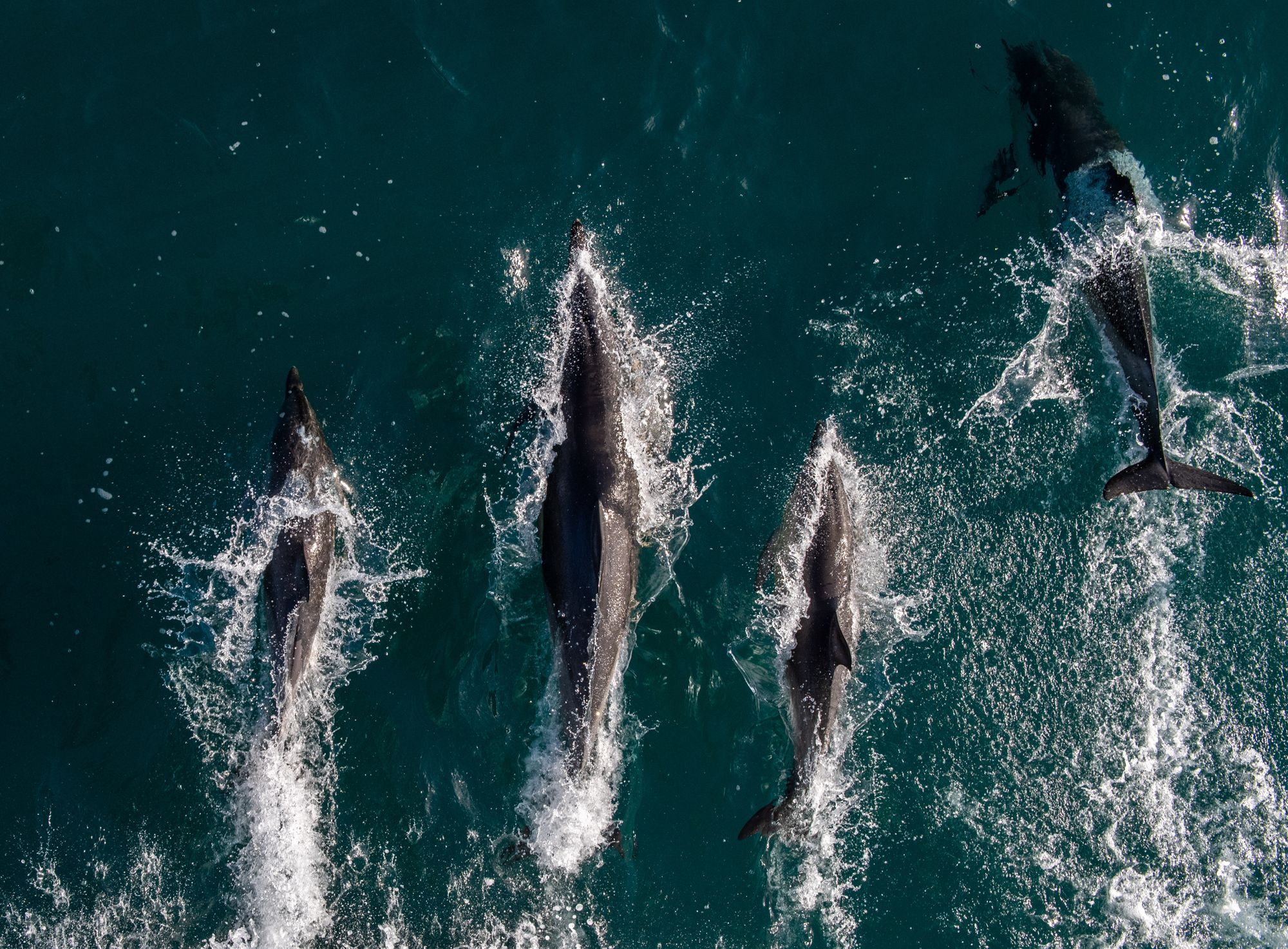
In 2020, the Sussex Dolphin Project first noticed a disturbing correlation between the presence of supertrawlers in Sussex, and an increase in dead dolphins washing up on our beaches.
Since then we have been working to raise awareness of these colossal factory trawlers and the impacts they have on our dolphins and local marine ecosystem, and pushing for mandatory remote monitoring to hold these vessels accountable.
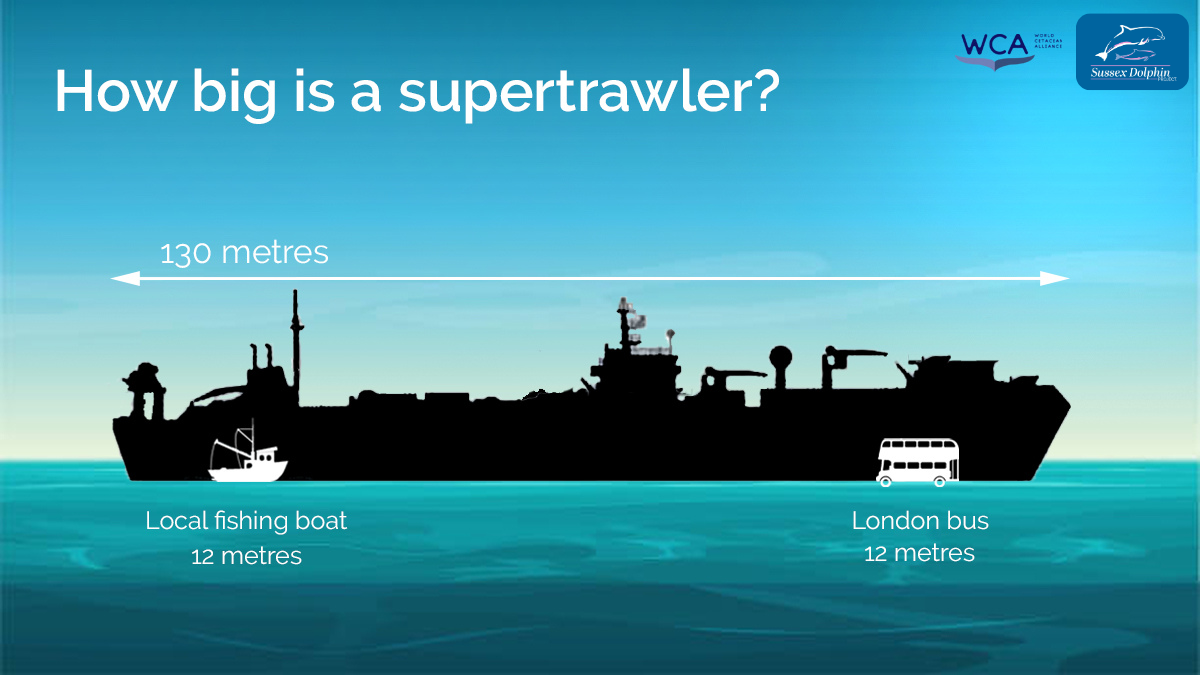
95–144 m
Typical length of a supertrawler
Weeks at sea
Catch is processed and frozen onboard
1,000s of tonnes
Of fish stored in a single voyage
What is a supertrawler?
A floating fish factory
Supertrawlers are also known as Pelagic Freezer Trawlers. Typically ranging from 95 to 144 metres in length, these industrial-scale ships are designed to catch vast quantities of fish.
Unlike traditional fishing boats, supertrawlers are equipped to catch fish, and also to process, package, and freeze their catch onboard. This allows them to remain at sea, sometimes for weeks at a time, without returning to port, enabling the vessels to store thousands of tonnes of fish during a single voyage.
The nets
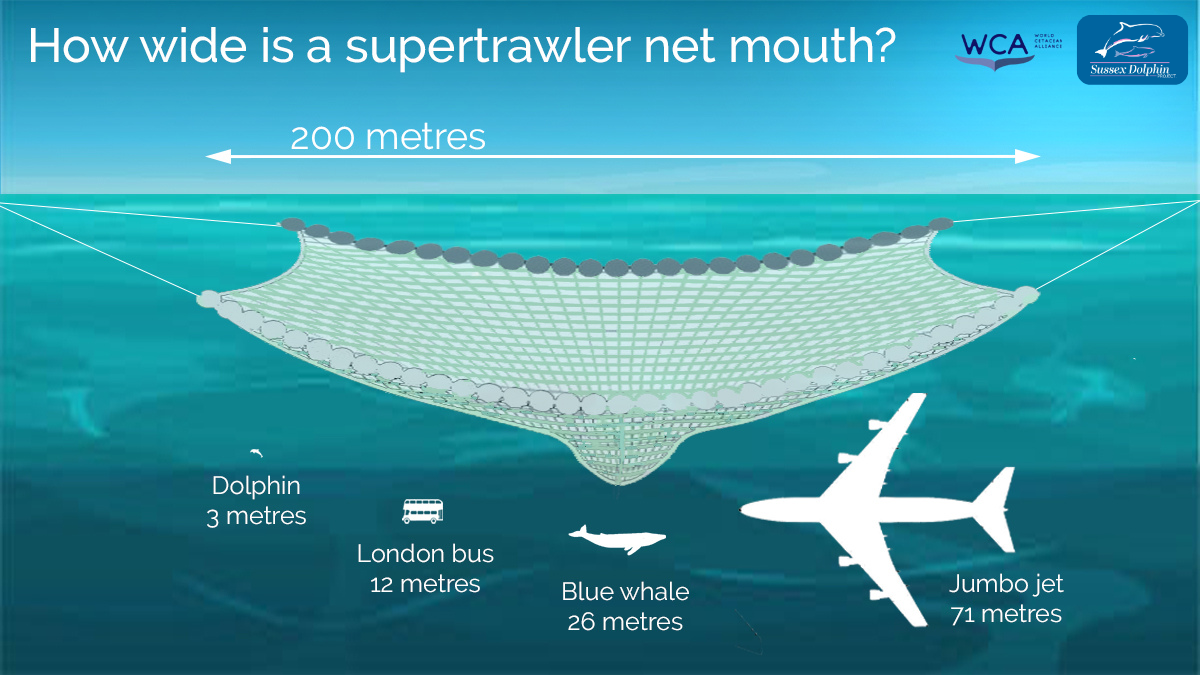
Big enough to surround a whole school of fish
The size of the vessel is only part of the concern. The size of the nets used by supertrawlers allows them to surround entire schools of fish at once.
Why it matters
The impact on dolphins
Bycatch
Unfortunately, these same schools are often being hunted by dolphins and other large marine predators, which can result in unintended bycatch when the predators become trapped alongside the targeted fish.
Less food for predators
Environmental concerns also extend beyond bycatch. Many of the species targeted by supertrawlers, such as herring and mackerel, play a vital role in the marine food web as prey species. Large-scale removal of these prey species can reduce the food available for dolphins and other large marine predators.
Campaign update · 2024
Dolphins Aren’t Discard
Stepping forward in the fight for transparency with supertrawlers in English waters
In partnership with
The end of 2023 brought renewed optimism for our campaign to hold supertrawlers accountable in the English Channel. In December, DEFRA (Department for Environment, Food & Rural Affairs) launched a promising consultation focused on the long-term integration of Remote Electronic Monitoring (REM) in English waters. The plan was to prioritise large pelagic trawlers, aiming to bring their operations into sharper focus through monitoring technology.
However, despite our hopes for swift action, DEFRA’s response to the consultation revealed several key challenges in turning this vision into reality. Here, we delve into what’s been achieved, what remains uncertain, and what it means for marine life—especially dolphins and other sensitive species.
DEFRA’s response
Key issues with the REM implementation plan
DEFRA’s response highlighted a few major sticking points that could delay the progress of the REM initiative:
1
Voluntary adoption and unclear timelines
DEFRA’s plan starts with a voluntary phase, which introduces ambiguity. Without a fixed timeline for transitioning to mandatory REM use, the effectiveness of the programme relies heavily on the cooperation of vessel operators—a major hurdle when dealing with large industrial fisheries.
2
Shortage of volunteers
Despite the initiative, only one vessel—a supertrawler named the Frank Bonefaas, which is the only supertrawler flagged to the UK—has volunteered for REM. This raises questions about how DEFRA will proceed if additional vessels do not step up for monitoring.
3
Lack of detail on REM configuration and data collection
There’s limited information on how the REM systems will actually be set up to monitor sensitive species interactions. The specifics of how the cameras and equipment will capture bycatch and monitor species too large to pass through the chutes are still unclear.
4
Uncertainty around data processing and public access
While DEFRA has stated that the collected data will be held on the servers of the Centre for Environment, Fisheries, and Aquaculture Science (Cefas) and shared with the Marine Management Organisation (MMO), there’s been no assurance that this information will be made available to the public. Transparency is crucial for accountability, and the absence of a public access plan limits the potential impact of REM.
What we found out
New information and a step forward—but not enough
On October 3, new details about the programme’s progress finally emerged. Through a Freedom of Information request, we learned about the REM setup on board the Frank Bonefaas, including:
The setup on the Frank Bonefaas is a welcome development but highlights the slow pace of progress. With only one vessel participating in the REM trial, the campaign for transparency and marine life protection remains an uphill battle.
14
Cameras covering comprehensive views
The cameras on the Frank Bonefaas provide detailed views of the vessel’s operations, including the port, starboard, and stern areas, as well as every step in the onboard processing of the catch—from separation to sorting and freezing.
Monitoring objectives for the trial
The trial’s objectives on the Frank Bonefaas include several critical goals:
- Verifying accurate documentation of the catch.
- Ensuring full retention and identification of unwanted catches.
- Monitoring interactions with sensitive species.
- Optimising the REM setup specifically for large pelagic freezer trawlers.
The trial will test the viability of transferring data remotely and assess whether REM can handle the high data volumes from supertrawlers effectively.
What happens next
The Path Forward
Without stronger commitments from DEFRA or a clear timeline to make REM mandatory, it’s uncertain when—and if—we’ll see widespread adoption of this vital technology on all relevant vessels.
As advocates for marine conservation, we continue to press for full transparency and prompt action. The current REM trial is a step in the right direction, but it’s clear that more needs to be done to protect marine life in the English Channel. Ensuring public access to REM data and a definitive timeline for expanding monitoring will be critical for building the accountability we need.
Our journey is far from over. Together, we will keep pushing until every vessel in our waters is held accountable, ensuring a safer habitat for dolphins and all marine species at risk from industrial fishing practices.
Help us keep pushing
Your support funds our research and campaigning for dolphins in Sussex.